What belongs in it?
Anything you are spending effort trying not to forget.
A brain dump is the practice of writing down the tasks, reminders, ideas and loose thoughts occupying your attention before deciding what to do with them.
A brain dump is an unsorted capture of whatever you keep trying to remember. It can include practical tasks, unfinished conversations, ideas, appointments to book, things you are waiting for and small jobs that keep resurfacing.
People often use one when loose tasks are crowding each other, ideas are mixed with obligations or it is difficult to see where to start. The immediate goal is not a perfect plan. It is a visible record of what has been competing for attention.
Anything you are spending effort trying not to forget.
Categorising, prioritising, scheduling or solving every captured item.
The process becomes harder when capture and organisation happen at the same time. Pausing to choose a category, due date or perfect wording gives every new thought a decision attached to it.
Write the thought in the simplest form that will make sense later. Once the flow slows down, return and decide what each item means.
Use paper, a notes app or any simple capture space. Choose the option with the least friction right now.
Capture tasks, reminders, ideas, things you are waiting for, small jobs and large jobs. Do not organise them yet.
Completeness matters less than getting enough onto the page to see what has been competing for attention.
Only now clarify vague items, cross out what is irrelevant and notice what needs an action.
Not everything you captured becomes today’s task. Separate what matters now from what can be scheduled or left for later.
Captured items are possibilities and reminders. Today’s priorities are the few outcomes you deliberately bring into focus.
Put appointments and deadline-sensitive work into a calendar or time block. You do not need to schedule every item.
You do not have to solve the whole list. A safe place for later items is already useful.
Imagine this is the first unsorted pass:
The original list has not vanished, and nothing needed an elaborate category system. The useful change is that only three items are asking to be handled today.
These tools work better when each has a clear purpose.
| Tool | Purpose | Question it answers |
|---|---|---|
| Brain dump | Capture without sorting | What am I trying to remember? |
| To-do list | Organise actionable work | What could I do? |
| Daily plan | Choose what matters now | What belongs in this day? |
A simple follow-through keeps the dump from becoming another forgotten list.
Write it down.
Decide what it means.
Select what matters now.
Place timed work.
Begin one next step.
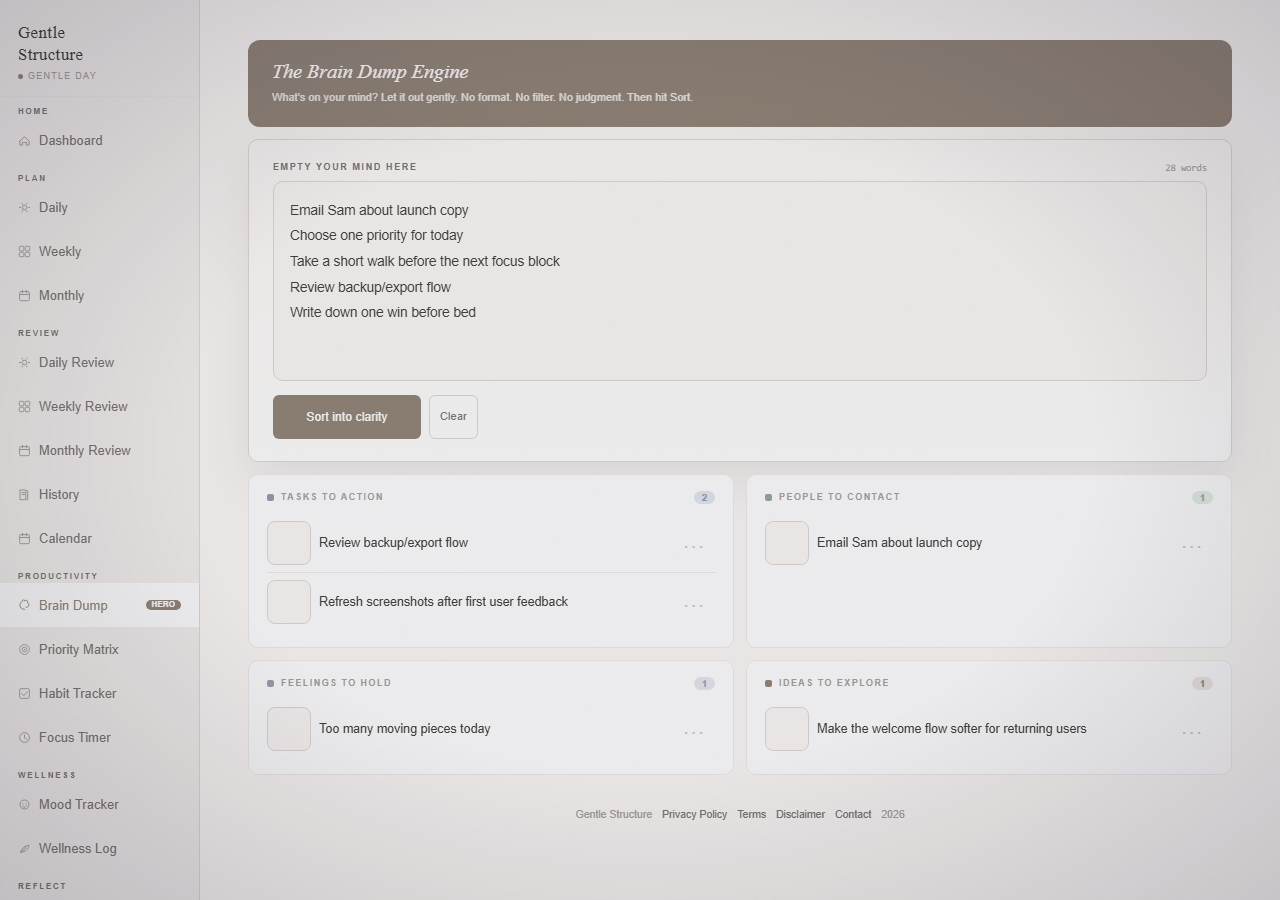
Gentle Structure includes Brain Dump beside the daily planning tools. Capture loose thoughts first, choose a few priorities, give time-sensitive work a place in Daily Planning, use a focus session for one task and reflect afterward.
The tools support the sequence without requiring every captured thought to become today’s task.
There is no required schedule. A brain dump can be useful:
It is the practice of capturing tasks, reminders, ideas and loose thoughts before sorting or planning them.
Long enough to capture the thoughts actively competing for attention. A few minutes may be enough; there is no required duration.
Write tasks, reminders, ideas, things you are waiting for, appointments to arrange and anything else you keep trying to remember.
No. Capture first and sort afterward so the initial stage stays easy.
Clarify the items, choose what belongs today, schedule time-sensitive work and leave the rest safely captured.
No. A brain dump captures without sorting. A to-do list organises actionable work, while a daily plan chooses what matters now.
Yes. Paper, a notes app or a dedicated Brain Dump feature can all work.
Use it when loose thoughts begin accumulating or before planning. It does not need to become a rigid daily rule.
Yes. Brain Dump is included alongside priorities, Daily Planning, focus sessions and reviews.
Gentle Structure brings Brain Dump together with daily priorities, planning, focus and reflection.
Start your 7-day free trial